
After weeks of Super Bowl festivities and heavy rainstorms, the San Francisco Botanical Garden offered a tranquil escape in the form of beautiful magnolias.
Magnolias reached peak bloom around President’s Day weekend, drawing visitors to the 55-acre garden tucked inside Golden Gate Park for the final days of Magnificent Magnolia Celebration Week, which concluded on Feb. 22.
Magnolias are among the oldest flowering trees on earth, predating bees by millions of years. According to The Marginalian, Buddhist monks in China planted white-blooming magnolias at their temples as symbols of purity as early as A.D. 650.
San Francisco’s own relationship with the flower runs deep. In 1940, the magnolia campbellii made U.S. history when it bloomed for the first time, drawing massive crowds to the garden, according to the Gardens of Golden Gate Park. That original tree still stands today, now part of a collection of more than 200 magnolia trees.
“When we lived in San Francisco, I used to bring my children to the gardens,” said Tracy Park, who now makes the trip up from San Carlos. “It was both a sanctuary to escape the busy city life and a classroom where we could discover and learn about many different flowering plants.”
The magnolias’ short-lived bloom, just a few weeks each year, only adds to their draw.
“Since there is a relatively short window to view their gorgeous flowers, it’s exciting to be there when they’re in full bloom,” Park said. “You feel so lucky to witness something so pretty.”
That sense of wonder is exactly what Nichole Davis, education coordinator for the Gardens of Golden Gate Park, the nonprofit that manages the garden, hopes visitors carry with them.
“There are so many folks who don’t take the time to slow down and notice the plants around them,” Davis said. “I think that is why people love this place so much. It’s a safe space for people to enjoy, relax, and connect to the plants, even if they don’t learn everything about them.”
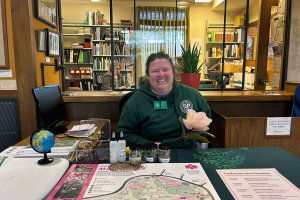
“This past Valentine’s Day, we interacted with 350 people at our welcome table alone,” Davis said.
(Annika Kumar)
Behind that sanctuary is a dedicated staff. Davis noted that horticulturalists, professionals specializing in the cultivation of plants, are assigned to specific areas of the park and are responsible for the care of the plants in their regions, a level of care evident in every acre of the grounds.
Davis is also passionate about who can access that experience. Non-residents pay between $3 and $15 to enter, depending on age, but San Francisco residents get in free.
“San Francisco is a very expensive city,” Davis said. “I really appreciate that the gardens give that opportunity to residents.”
The research backs her up. A study from Denmark’s University of Aarhus, which tracked nearly a million people over time, found that those who grew up with the least access to green space had as much as a 55% higher risk of developing psychiatric disorders such as depression, anxiety, and substance abuse later in life.
San Francisco, for all its density and cost, has always understood that its gardens are not a luxury.
Few people understand the garden’s pull better than Peggy Bannan and Bob Johnston, a couple who have been visiting for decades. Johnston has been visiting for 70 years and considers it among the top 10 parks in the world. For him, the magnolias never lose their magic.
“It’s always special,” Johnston said. “And you never tire of them.”
For those who haven’t yet visited the park, Bannan and Johnston’s advice is simple: the flowers are waiting for you.
“People just need to know that they’re here,” Bannan said. “Just show up.”