
Tariffs are driving up costs across local Bay Area agriculture, with uncertainty surrounding the time frame of their effectiveness.
The White House Fact Sheet states that the tariffs aim to reduce the trade deficit and bolster domestic production.
“Once you realize a tariff is a tax, then you can start talking about the pass-through of that tax to prices. So the thing to make perfectly clear is tariffs increase prices. The underlying question is, by how much?” said Anson Soderbery, associate professor of economics at Purdue University’s Daniels School of Business.
Soderbery’s paper was cited as a calculation for the current federal tariffs in the U.S. Trade Representative’s tariff calculations.
“The whole point of that paper, essentially, was to not look at an individual unit and set policy uniformly across that unit,” Soderbery said.
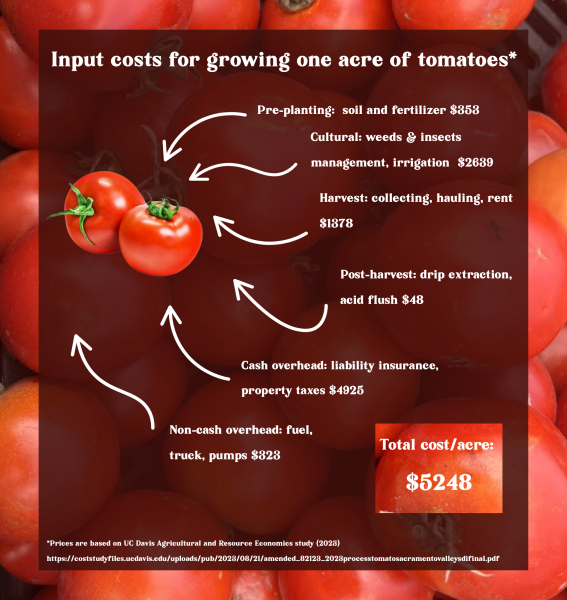
Now local farmers are seeing the effects of the reciprocal tariffs. Andrew Regalado of Regalado Farms runs a family-owned farm in Gilroy. He says the boxes, some of which were “made in Canada” and others “in China or different parts of Mexico,” have increased in price.
“I think two years ago, it was $20. Now I’m paying $35 for them,” Regalado said.
Soderbery explains that the reasoning behind tariffs is to raise the price so that domestic producers look more competitive in a particular market. Tariffs that are used on input costs also affect farms.
“If you put a tariff on machinery, but farmers need machines, then it passes through to the domestic market for agricultural goods,” Soderbery said.
Regalado says he’s also noticed an increase in machinery pricing.
“Tractor parts come from Germany, Spain, or even Japan. Because everything’s brand new, they’re pretty expensive,” Regalado said.
He notices that the price of the seeds themselves have also been raised. In the American Seed Trade Association‘s response to the federal tariffs, association President Andy LaVigne states that the seed trade gives farmers “access to the best seeds and agricultural innovations in the world.”
This affects the prices the farms set, according to Regalado.
“Five years back, it was $2.50 or something a pound. The fruits have been going up to $3.75,” said Iker Ramos of Resendiz Farms. “Everything has to go up, paying the workers, transporting, gas, everything. All that stuff plays a part.”
Along with other economic factors, residents face the new and higher prices at the Redwood City Kiwanis farmers’ markets.
“I do get a little bit of sticker shock here for almost $4 a pound for simple things like peaches,” said Henry Miller, a Redwood City resident who has been going to the Kiwanis farmers market for 30 years.
Miller says that during closing time, the farmers would usually slash the prices to get rid of produce, “but that doesn’t seem to happen anymore.” Tariffs from all sorts of input costs reverberate through the agricultural industry.
“If prices go up, just kind of trace that through the economy, and you can, you can start inferring how that affects other industries,” Soderbery said.
As for the time frame of when the tariffs will allegedly go into effect, researchers find it hard to predict, given the uncertain factors, Soderbery says.
“I think one of the big issues with how these policies are being rolled out is no one is really certain about their size, breadth, or permanence,” Soderbery said.
Soderbery says that if farmers are unsure whether or not this protection will stay in place, making that investment into American-made or imported machinery can be a complicated proposition.
“I’d like to remove them, because boxes are cheaper for me, certain seeds are cheaper too, as well, and I’m able to afford to pay another worker,” Regalado said.
Currently, Regalado sees no possible benefits of the tariffs.
“Everything goes up pretty much, from my point of view,” Regalado said.
Instead of imposing tariffs, Regalado requests that policymakers first understand the local farmers and their situation.
“If the government wants to come over and look at us, they should definitely come visit the farming,” Regalado said. “They can see that we’re hardworking.”