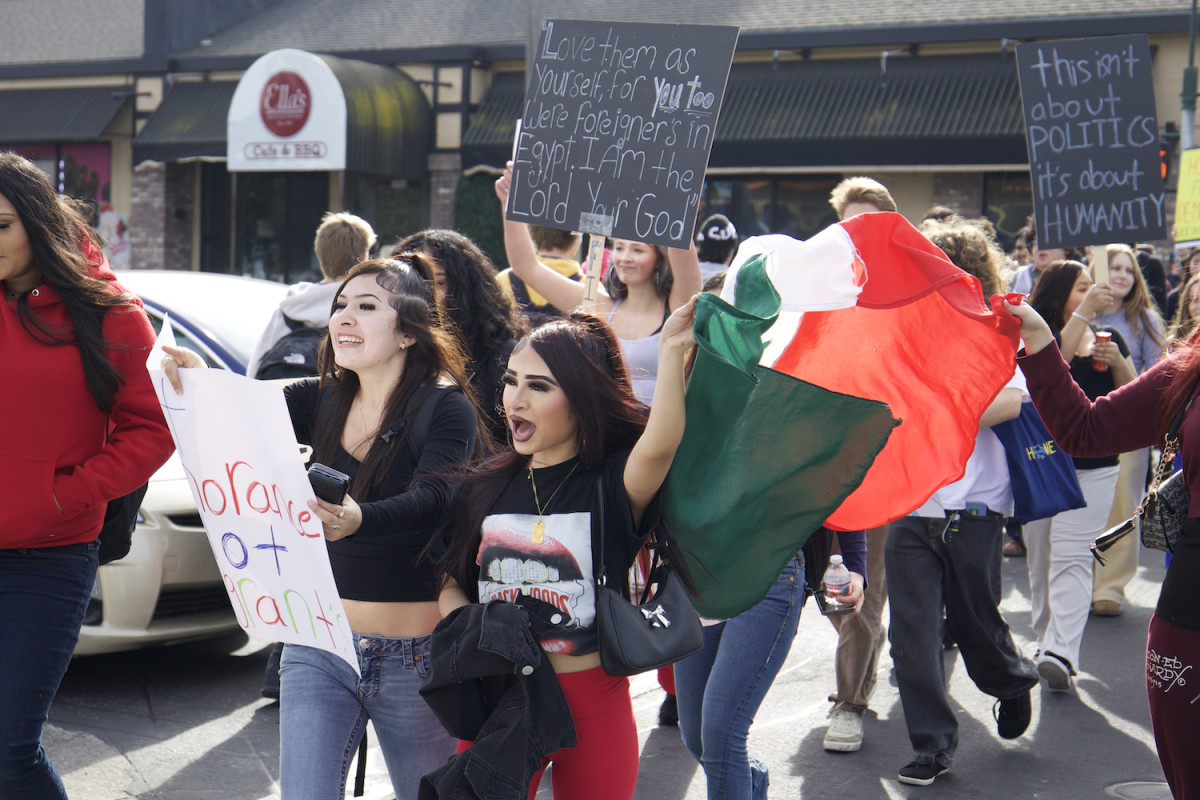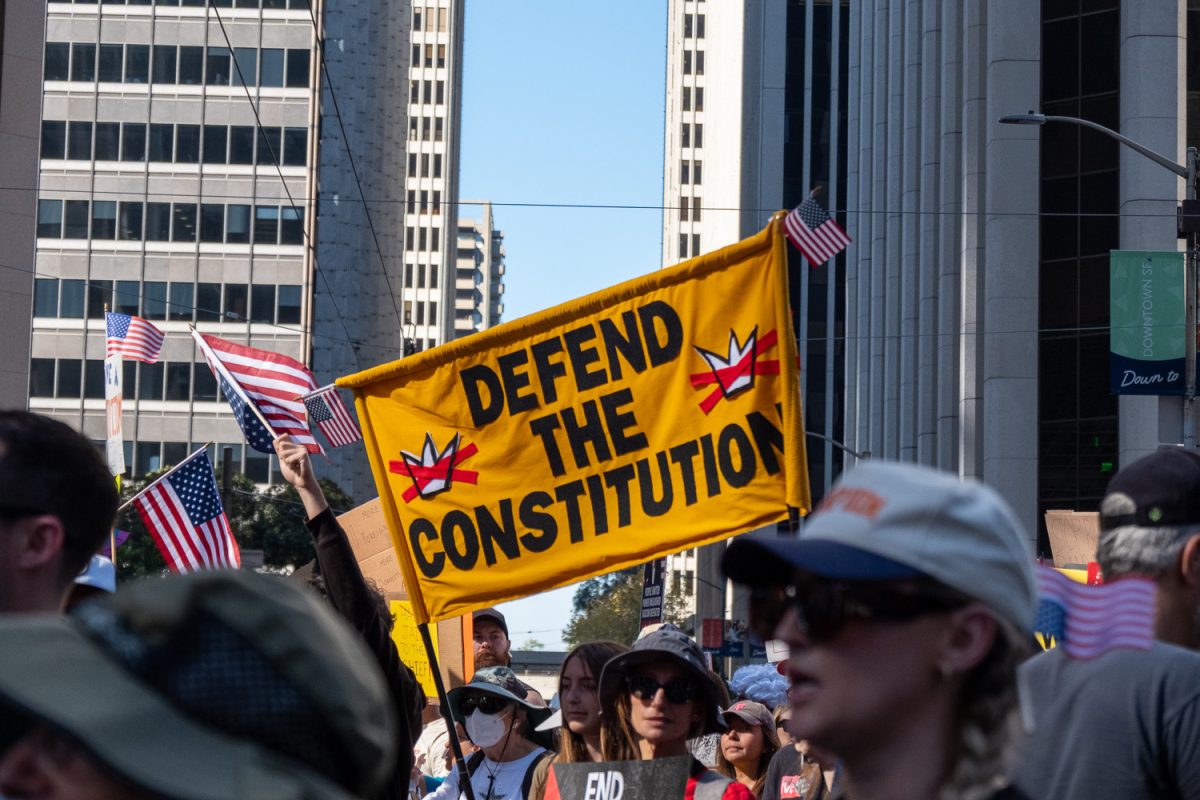

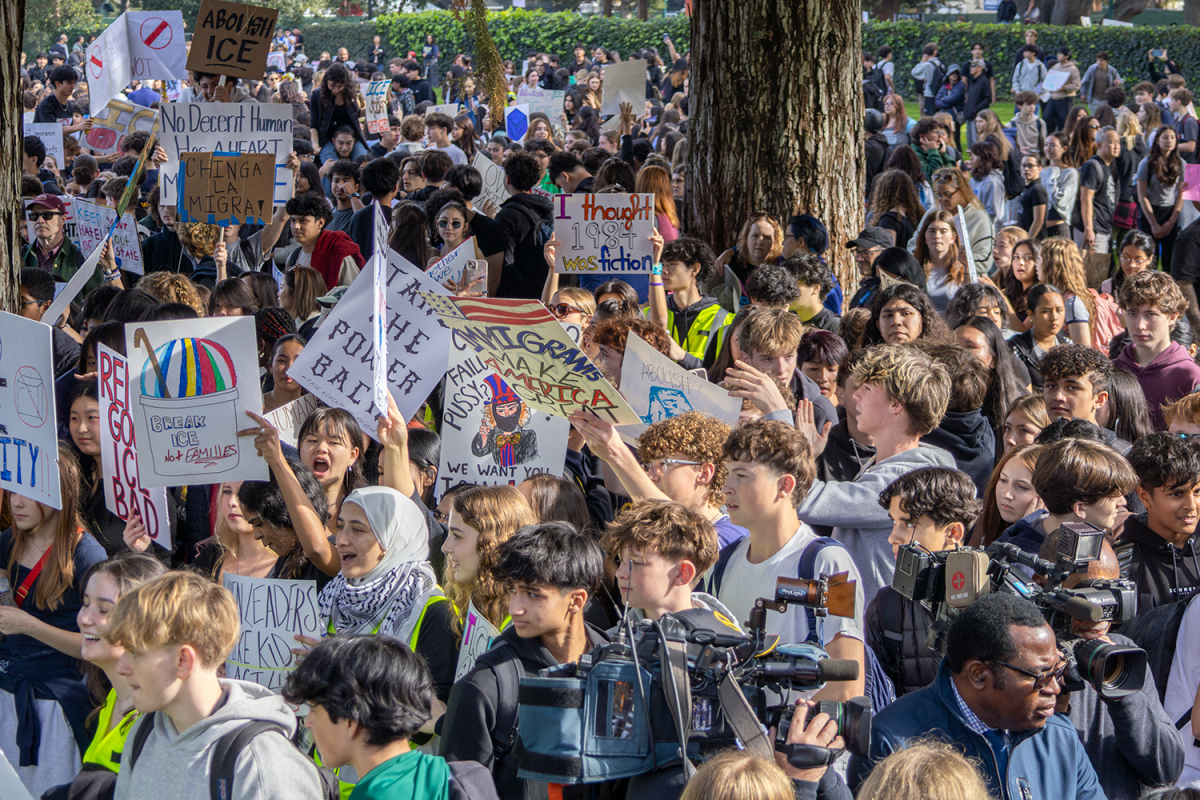
Hundreds of students from across the San Mateo area walked out of school on Jan. 30, converging at Central Park to protest the actions of U.S. Immigration and Customs Enforcement (ICE).
Though the walkout was organized by two students at Hillsdale High School, the event expanded beyond their campus with coordination from students at Aragon High School, Burlingame High School, San Mateo High School, The Nueva School, and Crystal Springs Upland, as well as middle school students from Parkside Middle School and Abbott Middle School.
The demonstration occurred amid a wider wave of protests across the country, as criticism of ICE has intensified in recent weeks with highly publicized fatal shootings, including the deaths of Alex Pretti and Renee Nicole Good during ICE-related actions in Minneapolis.
During the walk, student walkout committee members — identified by neon vests — guided participants along the 1 to 2 mile walk, or roughly 3 miles for Hillsdale students, with law enforcement monitoring routes.
The committee members were also tasked with leading call-and-response chants calling for immigrant rights and an end to ICE enforcement, with those messages reinforced by handmade signs and flags of those proudly representing participants’ communities.
As students walked and gathered in the park, onlookers and passing vehicles honked in solidarity.
“I think it sends a really good message to see a bunch of people out here supporting the anti-ICE movement,” said Jason Musselman, a senior at Hillsdale who served as a student walkout committee member. “There’s tons of people driving and walking through here, so even for people who aren’t specifically attending, they’ll spread the message, and I think it’s just really powerful having all these people here showing up.”
Behind the walkout
Sitting in Barnes & Noble for two hours, Hillsdale senior Brianna Hafiz and Emma Sevilla quickly got to work.
With less than a week before the event, the two handled multiple tasks to ensure the walkout happened: back-and-forth emails, finding trusted adults, and reaching out to other schools that were also planning their own walkouts.
“We emailed our history and English teachers since they were adults we knew would be a good resource. Even if they couldn’t outwardly encourage anything, if they could guide us in navigating how to build a student-led walkout, we knew that would be great,” Hafiz said. “There were a lot of emails between us, our teachers, and the administration, on top of lots of Canva editing for social media.”
Hafiz and Sevilla, along with other organizers, collaborated to plan the event’s logistics, agreeing to have students leave their campuses around 11:30 a.m. to 11:45 a.m. to walk toward San Mateo’s Central Park.
During their planning, the two seniors, along with other organizers, also tried to gear the event to be accessible and safe for all participants. With the help of the San Mateo Police Department (SMPD), organizers received suggestions on how to map out their walking routes to ensure a safe walk to the park.
“We shared on our posts that students who didn’t feel comfortable participating in the walkout could wear blue or help make posters even if they weren’t going to walk out with them,” Sevilla said. “Our flyers also included step-by-step instructions for responding to and dealing with agitators. Our goal is not to provoke, but to have a peaceful protest to impact our community.”
However, Hafiz shared that many threatened other organizers on platforms such as Instagram, prompting her and Sevilla to contact local officials to protect the student body.
“We didn’t experience this directly, but organizers from Aragon and San Mateo have gotten threatened through Instagram messages. There was also a screenshot circulating of this random troll online in the comment section saying, ‘We’re going to call ICE on you,’ and ‘We’re going pepper spray you,’ and those are the kind of threats we have to deal with,” Hafiz said.
Even in the face of intimidation and safety concerns, both students and adult protestors shared that the walkout’s fundamental purpose — encouraging civic engagement and collective action — made such challenges worth enduring.
“I teach students what their rights are and how different people have participated in activism throughout history,” said Eric Kim, a history teacher at Hillsdale. “History isn’t just things that we read in a textbook. It’s in front of us every single day, so getting to participate in these kinds of moments really encourages students to understand that they really do matter. Their individual voices, when used collectively, can really have meaningful change.”
From personal experience to collective action
For some students, participation in the protest was tied to a personal connection with the immigrant community.
“My parents are immigrants, and I think that it’s really important to spread their story and other stories as well,” said Freya Adrianwala, a senior at Hillsdale High School.
Hafiz echoed this deeply-rooted motivation, noting the differences between watching events in the news and witnessing their local impact.
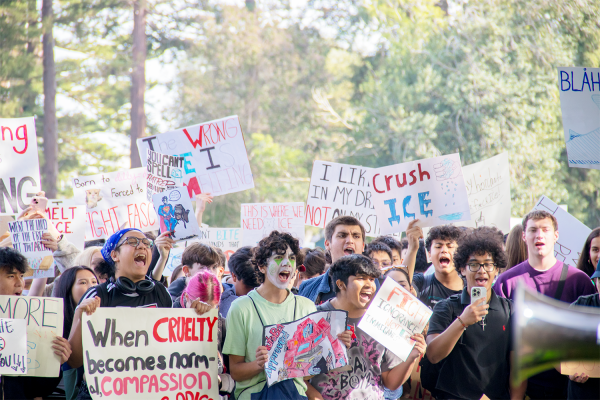
“There’s a lot of current events I’ve been keeping a close eye on in the U.S. for months, and a lot of that was a big motivator for me. But for me in particular, I’m from an immigrant background – my mom immigrated from Mexico. I kind of have this personal connection to this issue,” Hafiz said. “Obviously, it’s devastating to see what’s happening in the news, but seeing what’s happening in my local community was what pushed me to get involved in a walkout.”
According to Pew Research, about one in five Hispanic adults personally knows someone who has been detained or deported by federal immigration authorities in the past year, an amount far higher than other major racial and ethnic groups.
Other high school students, adults, and even middle school students were motivated by recent events to participate and fight for what they believe in.
“What’s been happening on the news lately is just terrible. I feel like somebody needs to speak up,” said Maya Valdivia, a student at Parkside Middle School.
Some students said they were nervous about leaving campus, concerned about clearing the absences or falling behind in classwork. Those who attended, however, believed their positive impact would outweigh the possibility of negative repercussions.
“One of our teachers yesterday said something that really inspired me. People being affected by ICE are uncomfortable every day, so U.S. students who aren’t being directly impacted can be uncomfortable by having an unexcused absence on our transcript or walking out of class for five minutes,” Hafiz said. “We’re experiencing a sliver of the pain and discomfort that these families are experiencing every single day and minute of their lives, so I think that weighs it out for me.”
Some teachers’ support extended beyond offering encouragement from the classroom and into joining the walkout alongside students. Pam Seligman, a government, economics, and United States history teacher at Hillsdale, was one teacher who participated in the protest.
“I walked out of class today in support of my students and to oppose what is happening in Minneapolis and nationwide. I teach history, government, and economics, so my students are listening about rights and civic engagement,” Seligman said. “No matter what lessons we ever could have dreamed of, nothing beats being out here learning and doing it yourselves.”
According to Seligman, both students and staff were well supported by the district administrators throughout the event, as well as numerous SMPD officers who accompanied the students for safety.
Administrative figures offered similar support for their students to Seligman. Fernando Figueroa, an assistant principal at Abbott Middle School, felt that his students’ actions reflected what they were being taught in the classroom.
“Our students are socially aware and very conscious. We have spent time talking about this before we came out, so they got to see what we talked about in action,” Figueroa said.
In addition to administrators and teachers, parents came to support their children. Many of them felt a similar pride in children’s activism.
One parent participant was Michael Gonzalez, a father of children participating in the walkout, attending Abbott Middle School and Hillsdale High School.
“I’m excited for them, for my kids, to experience something like this, and hopefully it has an impact on them and their future,” Gonzalez said.
Looking forward
The protesters at Central Park were a part of a nationwide call to action on Jan. 30.
In the Bay Area, the impact extended beyond student walkouts. Several businesses closed for the day, and additional demonstrations took place in San Francisco, according to the San Francisco Chronicle.
For the organizers, the day’s success was measured not just by the immense turnout of students, but also by the visibility and conversations the walkout sparked.
“There’s no numerical way to define success. I think it’s showing people that there are people who support you, and if we can change one person’s viewpoint on this, then we did something,” Sevilla said.
Similar to Sevilla, Col Glazier, a U.S. history teacher at Aragon, shared how recognizing the influence of actions like the walkout could encourage others to see themselves as part of a larger community working towards change rather than feeling isolated in their efforts.
“The most likely impact of today is that people will realize there are people like them,” Glazier said.
Many of the protestors believe that change will come through advocacy and by raising others’ awareness of the current situation, particularly among young people.
“We want to emphasize how important this is to do. I think student activism is such a crucial thing in upholding a democracy, upholding our values, upholding our rights and civil liberties,” Hafiz said. “We need to see more student voices out there, because cliched as it sounds, we’re the future. We’re what’s going to be there in 10 years.”